Elizabethan society
Social role of women during the Elizabethan era
The Taming of the Shrew is one of Shakespeare’s earliest comedies, where the author focuses on courtship and marriage and devotes a great deal of attention to married life after the wedding. Because of this, we are going to focus our study on social role of women during the Elizabethan era, and how Shakespeare presents to the audience in this play a woman who does not fits in it.
- 1. Role of women during the period
In Shakespeare’s days, the stereotypical images of both men and women were very rigid. The Elizabethans had very clear expectations of men and women, and in general men were expected to be the breadwinners and women to be housewives and mothers. Elizabethan society was patriarchal, and men were thought to be somehow superior to women, who were regarded as “the weaker sex”, not only physically but also emotionally. In this sense, it was believed that women always needed someone to look after them: their husband, their father, brother or another male relative.
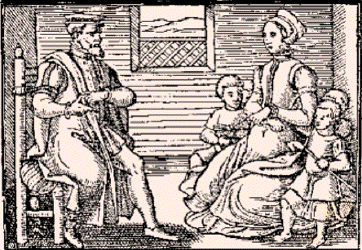
A husband instructs his obedient family. From Internet Shakespeare Edition.
1.2. Education:
Regarding education, although many women in this period were educated, they were educated at home by private tutors because women were not allowed to go to school or to university and, in addition to that, they should be educated separately from men. Elizabeth being on the throne also encouraged noble men to educate their daughters, as they did not want them to look dim in the presence of their very intelligent and highly educated queen. It wasn’t until the end of the 19th century that some universities were beginning to accept a few wealthy women to study degree courses. However, they were still educated separately from the men. They only learnt how to manage a household and the duties of a housewife. This kind of “domestic education” would let them find a husband, which was of vital importance for most women. In fact, single Elizabethan women were often thought to be strange people by those surrounding them. Being unable to stand the pressure by their neighbors, most single women ended up in convents. (Alchin, “Elizabethan Women”)
1.3. Marriage:
One common belief about the Renaissance is that children, especially girls, married young. In some noble houses marriages were indeed contracted at a young age, for reasons of property and family alliance, but in fact the average age of marriage was quite old–in the middle twenties. (Michael Best, Shakespeare’s Life and Times)
Man was considered to be the head of a marriage, and he had the legal right to punish his wife. The law regarded a married couple as one person, and the husband was that one. A dominant woman was unnatural, a symptom of disorder. Men thought of theirs wives and daughters as their property, and so did the law:
- Until 1882 women had to give up their property to their husbands when their married him.
- Until 1891 husbands were allowed by law to beat their wives “with a stick “no thicker than a man’s thumbs” and to lock them in a room if they wished.
- Except in extremely rare cases, a woman could not obtain a divorce and, until 1891, if she ran away from an intolerable marriage the police could capture and return her, and her husband could imprison her.
The wife’s subordinate status was based on religious conceptions of hierarchy. The Book of Common Prayer directs the priest to read, to the newly married pair, a homily which quotes the passage of St. Paul (Ephesians, 5: 22-5):
“Ye women, submit your selves unto your own husbands, as unto the Lord. For the husband is the wife’s head, even as Christ is the head of the Church, and he is the saviour of the whole body. Therefore as the Church in congregation is subject unto Christ: so likewise let the wives be in subjection unto their own husbands in all things.”
In The Taming of the Shrew, Kate, already tamed, gives a “lesson” to the other women on the «natural» domestic order. The imagery makes clear the correspondence between the family and the nation:
Thy husband is thy lord, thy life, thy keeper,
Thy head, thy sovereign . . .
Such duty as the subject owes the prince,
Even such a woman oweth to her husband,
And when she is froward, peevish, sullen, sour,
And not obedient to his honest will,
What is she but a foul contending rebel
And graceless traitor to her loving lord?
I am ashamed that women are so simple [foolish]
To offer war where they should kneel for peace,
Or seek for rule, supremacy, and sway,
When they are bound to serve, love, and obey.
(5.2.148-66)
This excerpt is a perfect example of how women were expected to be during this period. John Fitzherbert in A Book of Husbandry (1525), also says:
“Our English housewife must be of chaste thought, stout courage, patient, untired, watchful, diligent, witty, pleasant, constant in friendship, full of good neighbourhood, wise in discourse, but not frequent therein, sharp and quick of speech, but not bitter or talkative, secret in her affairs, comfortable in her counsels, and generally skilful in all the worthy knowledges which do belong to her vocation.”
Women who perhaps suffered most in this period were, ironically, those like the Queen who did not wish to marry. Tudor society did not have many avenues open to single women and, following the Reformation, those avenues were even less. Before, women were able to become nuns and look forward to a rewarding life in convents, perhaps be a Mother Superior one day. But with the Reformation, the convents were closed. Wealthy single women (heiresses of property) could look forward to being mistress of their estates and wield the power in the community this would bring, but for poor women, the only long-term “career” really open to them was domestic service. It was not surprising, therefore, that most women married. Marriage was seen as the desirable state for both men and women, and single women were sometimes looked upon with suspicion.
1.4. Women’s “place”:
As is the case of education, women were not allowed to enter the professions as law, medicine, etc., “their place” was home, they could work in domestic service as cooks or maids and of course, these were jobs for the lower class women.
1.5. Other aspects related to women during the Elizabethan era:
Women, regardless of social position, were not allowed to vote, but it isn’t strange if we take into account that only men of a certain social position were allowed to vote. Neither could women inherit their father’s titles. All titles would pass from father to son or brother to brother, depending on the circumstances. The only exception was, of course, the crown. This allowed Mary, and then Elizabeth, to reign. Writing literature was allowed to them but only if the subject was suitable for women: mainly translations or religious works. Acting on the public stage or write for the public stage was, completely forbidden; it was considered dishonorable for women (women did not appear on the stage in England until the 17th century). In Shakespeare’s plays, the roles of women were often played by young boys.
_______________________________
<<table of contents – – Katherine: an attempt of breaking social rules>>