1. «1984»
Read the novel here!
**********************KEY FACTS****************************
Type of work: Novel. Negative utopian, or dystopian, fiction.
Time and place written: England, 1949.
Date of first publication: 1949.
***************************************************************************
1984 is a political novel written with the purpose of warning readers in the West of the dangers of totalitarian government. Having witnessed firsthand the horrific lengths to which totalitarian governments in Spain and Russia would go in order to sustain and increase their power, Orwell designed 1984 to sound the alarm in Western nations still unsure about how to approach the rise of communism.
In 1984, Orwell portrays the perfect totalitarian society, the most extreme realization imaginable of a modern-day government with absolute power. The title of the novel was meant to indicate to its readers in 1949 that the story represented a real possibility for the near future: if totalitarianism were not opposed, the title suggested, some variation of the world described in the novel could become a reality in only thirty-five years. Orwell portrays a state in which government monitors and controls every aspect of human life to the extent that even having a disloyal thought is against the law. As the novel progresses, the timidly rebellious Winston Smith sets out to challenge the limits of the Party’s power, only to discover that its ability to control and enslave its subjects dwarfs even his most paranoid conceptions of its reach. As the reader comes to understand through Winston’s eyes, The Party uses a number of techniques to control its citizens, each of which is an important theme of its own in the novel.
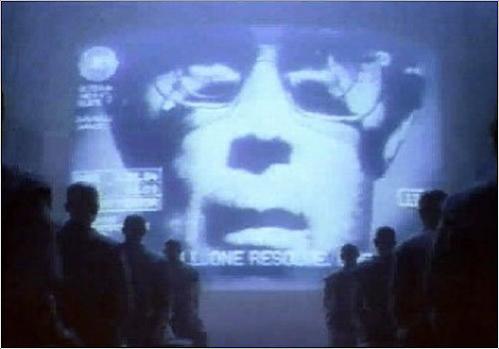
One of Orwell’s most important messages in 1984 is that language is of central importance to human thought because it structures and limits the ideas that individuals are capable of formulating and expressing. If control of language were centralized in a political agency, Orwell proposes, such an agency could possibly alter the very structure of language to make it impossible to even conceive of disobedient or rebellious thoughts, because there would be no words with which to think them. This idea manifests itself in the language of Newspeak, which the Party has introduced to replace English. The Party is constantly refining and perfecting Newspeak, with the ultimate goal that no one will be capable of conceptualizing anything that might question the Party’s absolute power.
Some of the ways in which language is manipulated by the Party are:
- Words with negative meanings are removed as redundant, so «bad» became «ungood».
- Root words served as both nouns and verbs, which allowed further reduction in the total number of words; for example, «think» served as both noun and verb, so the word thought was not required and could be abolished
- to remove all shades of meaning from language, leaving simple dichotomies: «goodthink» and «rimethink»
- Words with comparative and superlative meanings were also simplified, so «better» became «gooder», and «best» likewise became «goodest»
- Intensifiers could be added, so «great» became «plusgood», and «excellent» became «doubleplusgood».
Orwell displays the use of language to manipulate the general public of Oceania in order to accomplish a political goal. Newspeak reduced the intellect of the society of Oceania and closed its minds to the beauty of what language can become within a culture. Mirroring the language of the Russian Socialist Party, Newspeak was also used to catch the attention of the citizens with words like «Comrade»– making them feel accepted and as though they were actually part of something that was productive and world changing.
******************************************************************
******************************************************************
Related posts:
Politics and the English Language
The prevention of literature
Conclusion
 Eric Arthur Blair, better known by his pen name George Orwell and as the author of Animal Farm and 1984, was born in 1903 in Bengal, region of Eastern India, which was part of the British Empire. He was son of Richard Walnesley Blair, who worked in the Opium Department of Indian Civil Service, and Ida Mabel Blair. Due to certain gradual impoverishment of his family, he always described it as «lower-upper-middle class».


