"The universe is made of stories, not of atoms"

Archive for diciembre 14th, 2010


1. Men and women roles in Elizabethan society.

William Shakespeare´s comedies, as well as providing entertainment, reveal traditions, prejudices, specific mode of thought and behavior as well as beliefs typical of that historical period. For that reason, we cannot avoid historical and political connotations while reading Shakespeare’s plays. In order to understand how the society as a whole was regarded and what the roles of both genders were, you can read “Elizabethan society”, a post included in my first paper where this topic is developed. If you prefer a deep analysis of the topic, you will also find information on these two links:

Elizabethan England Life

Elizabethan era

Reading Shakespeare’s comedies we realize that there was a clear borderline between men and women, and their obligations were strictly divided. Men were given force and power while women had to content themselves to be obedient and submissive.

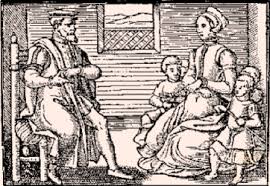
A husband instructs his obedient family. From Internet Shakespeare Edition.

On the surface, the comedies I am going to analyze ( The Comedy of Errors, Much Ado About Nothing, As You Like It and Twelfth Night) seem to prove that in Shakespeare´s times it was obligatory for a woman to marry well, be faithful and obedient to her husband and procreate children. In contrast, a man had to be well-educated and have polished manners, have high standards of proper behavior and know the arts and sciences. But a more detailed study of each of them indicates that the situation was not as simple as it seems to be at first glance.

********************************************************************

<< PREVIOUS – NEXT >>

********************************************************************

Related posts:

The Comedy of Errors

Much Ado About Nothing

As You Like It

Twelfth Night

Conclusion

3. «Much Ado About Nothing».

Read the comedy here!

**********************KEY FACTS****************************

Type of Work: Much Ado About Nothing is a comedy centering on the activities of two war heroes and the women they love. Shakespeare shifts back and forth between the stories of the couples—Benedick and Beatrice, Claudio and Hero—interweaving them into a unified whole. The story observes the three unities (place, time, and action) established by ancient Greek and Renaissance thinkers and writers.
Date Written: Probably 1598.
First Performance: Probably December 1598 or early in 1599.
First Printing: 1600 quarto edition by Valentine Sims for Andrew Wise and William Aspley; 1623 as part of the First Folio, the first authorized collection of Shakespeare’s plays.

***************************************************************************

Much Ado About Nothing starts with the end of a war: men are returning from battle, taking an active role, and women are waiting for them, acquiring  a passive role. It seems that with such a beginning, Shakespeare will deal with the traditional patriarcal society usual of his times. However, as the first act begins, the reader sees how Beatrice interrupts the conversation between Leonato and the Messenger. Doing so,  she already reveals her active role in this story by the interruption of a male conversation, an attitude that could be considered inappropiate for women at Elizabethan times.

BEATRICE

I pray you, is Signior Mountanto returned from the
wars or no?

Messenger

I know none of that name, lady: there was none such
in the army of any sort.

LEONATO

What is he that you ask for, niece?

HERO

My cousin means Signior Benedick of Padua.

Messenger

O, he’s returned; and as pleasant as ever he was.

BEATRICE

He set up his bills here in Messina and challenged
Cupid at the flight; and my uncle’s fool, reading
the challenge, subscribed for Cupid, and challenged
him at the bird-bolt. I pray you, how many hath he
killed and eaten in these wars? But how many hath
he killed? for indeed I promised to eat all of his killing.

(Act I, scene I)

Instead of leaving a secondary role for women, women are the centre of the main plot and taking part in the action. The major events, to a large extent, revolve around the female characters: Hero is the Claudio’s object of love and later of hate, Beatrice is the woman who express freely in a male’s world and the woman who turns Benedict into a “tamed man”; and finally, Margaret and Ursula also contribute, albeit on a smaller scale, to deceive Claudio into thinking that Hero is unfaithful and helping to win the heart of Beatrice towards Benedict respectively.

Woman are no longer voiceless in this play, as was usual in a patriarchal society ruled by men, Beatrice breaks the conventions through her freedom of expression. Furthermore, women are represented as equal to men. This is the case again of Beatrice, who argues with Benedict regardless of his position as a man. Definitely, although to a limited degree, women represented in “Much Ado About Nothing” reach a high social value and great importance compared with the conventional man’s superiority ideology of that time. In spite of giving them roles as wife and mother, here Benedict expresses his gratitude to his mother who brought him to life:

That a woman conceived me, I thank her; that she

brought me up, I likewise give her most humble

thanks: but that I will have a recheat winded in my

forehead, or hang my bugle in an invisible baldrick,

all women shall pardon me. Because I will not do

them the wrong to mistrust any, I will do myself the

right to trust none; and the fine is, for the which

I may go the finer, I will live a bachelor.

(Act I, scene I)

If we have seen in The Comedy of Errors how Luciana’s sense of identity within marriage contrasts with Adriana’s, here Beatrice and Hero are the representatives of opposite roles: Beatrice is a rebellious woman that could be represented as the active role or the protest against the conventional submissive attitude of women at Elizabethan times. She is the woman who dares to argue and to be as equal as men. Beatrice is also considered, to some degree, a woman whom men cannot control:

LEONATO

Well, niece, I hope to see you one day fitted with a husband.

BEATRICE

Not till God make men of some other metal than

earth. Would it not grieve a woman to be

overmastered with a pierce of valiant dust? to make

an account of her life to a clod of wayward marl?

No, uncle, I’ll none: Adam’s sons are my brethren;

and, truly, I hold it a sin to match in my kindred.

We can observe that Leonato does not take control over Beatrice’s decision of marriage, and in contrast to it, Leonato does rule over his daughter Hero in the decision of being married. Hero represents women’s submission: she is sweet and docile and most importantly obedient to her father’s decision of marrying her to Claudio. She is almost voiceless in the play, however in act three scene one we can see her taking a assertive role carrying out the plan of getting Beatrice and Benedict together . This is the only occasion where she takes an active role, the rest of the play she agrees and obeys with no opposition every single decision made by men.

******************************************************************

<<PREVIOUS – NEXT>>

******************************************************************

Related posts:

Men and women roles in Elizabethan society.

The Comedy of Errors

As You Like It

Twelfth Night

Conclusion

Related videos:

film_Much Ado About Nothing: part 1 …
7. Bibliography (Shakespeare. 2nd. p.)

_Jhonston, Ian. Critical Approaches to Shakespeare: Some Initial Observations [on-line]. May 1999, November 2001 [ref. November 2010]. Available in World Wide Web:

< http://records.viu.ca/~johnstoi/eng366/approaches.htm >

_Mabillard, Amanda. Shakespeare’s Audience: The Groundlings [on-line]. Shakespeare Online. 20 Aug. 2000. [ref. November 2010]. Available in World Wide Web:

< http://www.shakespeare-online.com/essays/shakespeareaudience.html >

_Mabillard, Amanda. Entertainment in Elizabethan England [on-line]. Shakespeare Online. 20 Aug. 2000. [ref. November 2010]. Available in World Wide Web:

< http://www.shakespeare-online.com/faq/entertainment.html>

_McMillan, Eric. The Greatest Authors of all Time: William Shakespeare [on-line]. 2002-2003 [ref. October 2010]. Available in World Wide Web:

< http://www.editoreric.com/greatlit/authors/Shakespeare.html >

_Encyclopaedia Britannica. Guide to Shakespeare [on-line]. [ref. November 2010]. Available in World Wide Web:

< http://www.britannica.com/shakespeare >

_Wikipedia. William Shakespeare [on-line]. [ref. November 2010]. Available in World Wide Web:

< http://en.wikipedia.org/wiki/William_Shakespeare >

_Wikipedia. Elizabethan Era [on-line]. [ref. November2010]. Available in World Wide Web:

< http://en.wikipedia.org/wiki/Elizabethan_era >

_Wikipedia. The Comedy of Errors. [on-line]. [ref. November 2010]. Available in World Wide Web:

<http://en.wikipedia.org/wiki/The_Comedy_of_Errors>

Wikipedia. Twelfth Night. [on-line]. [ref. November 2010]. Available in World Wide Web:

<http://en.wikipedia.org/wiki/Twelfth_Night>

_Hudson Shakespeare Company Website. [ref. November 2010]. Available in World Wide Web:

< http://hudsonshakespeare.org/index.htm >

_Literary Jewels. As You Like it a pastoral/romantic comedy. [ref. November 2010]. Available in World Wide Web:

<http://literarybonanza.blogspot.com/2009/10/as-you-like-it-as-pastoralromantic.html>

_Terrall, Erin. Shakespeare’s Disguised Heroines: Rosalind, Julia and Viola. [ref. November 2010]. Available in World Wide Web:

<http://www.associatedcontent.com/article/752063/shakespeares_disguised_heroines_rosalind.html?cat=38>

Boyd, Nataniel. The evolution of Shakespeares’s women. [ref. November 2010]. Available in World Wide Web:

<http://www.suite101.com/article.cfm/interpreting_shakespeare/63322>

6. Conclusion

As we have seen in this paper the manipulation of language in order to control thoughts, the behavior of people and even their capacity of reaction, is not only possible but also a fact.

Through history we see examples of this manipulation and how «effective» it was, for example, Hitler speeches leaded a whole country to the most terrible holocaust ever seen. In the same way, in Orwell’s writing, the society of Oceania in his novel, 1984, is manipulated through a simplistic language that reduced the intellect of the society and closed its minds to the beauty of what language can become within a culture. By creating absurd scenarios, Orwell was able to portray his own views regarding Socialism in Animal Farm, where the pigs gradually twist and distort a rhetoric of socialist revolution to justify their behavior and to keep the other animals in the dark, who are unable to react against the them due to the use of language made by the pigs.

So, as we have seen language can be used in order to accomplish a political goal and, of course, it can also be a dangerous weapon in the wrong hands, leading society to totalitarian regimes as in Animal Farm or 1984.


5. List of all the political writings of George Orwell

Novels

Essays

Newspaper Columns, Letters and Editorials 1943-1946

Essays related to the Spanish Civil War:

4. «The Prevention of Literature»

Read the essay here!

**********************KEY FACTS****************************

Type of work: essay

First published: 1946

****************************************************************************

Orwell introduces his essay by recalling a meeting of the PEN Club, held in defence of freedom of the press, in which the speakers appeared to be interested primarily in issues of obscenity and in presenting eulogies of Soviet Russia and concludes that it was really a demonstration in favour of censorship. In a footnote he acknowledges that he probably picked a bad day but this provides an opportunity for Orwell to discuss attacks on freedom of thought and the enemies of intellectual liberty. He declares the immediate enemies of freedom of thought in England to be the concentration of the press in a few hands, monopoly of radio, bureaucracy and the unwilllingness of the public to buy books. However he is more concerned with the independence of writers being undermined by those who should be its defenders. What is at issue is the right to report contemporary events truthfully. He notes that 15 years previously it had been necessary to defend freedom against Conservatives and Catholics, but now it was now necessary to defend it against ‘Communists’ and fellow-travellers declaring that there is «no doubt about the poisonous effect of the Russian mythos on English intellectual life».

In this essay we see how language can by manipulated by giving to the people the information we want them to know. So, this is not the manipulation of the language or words itself but the way we use or construct it. In this way, we also reduce the capacity of people to think about what is really happening, something that also happens in 1984 or Animal Farm.

This is a topic of great interest nowadays, due to we are living in a mass communication era, where a constant flow of information arrives to us. So, we depend on what newspapers, TV-news… tell us about what is happening all around the world. They have the power of language to build beliefs, thoughts and ideas, and this is the most dangerous weapon of mind control.

3. «Politics and the English Language»

Read the essay here!

**********************KEY FACTS****************************

Type of work: essay.

Date written: 1946.

Date of first publication: April 1946 issue of the journal Horizon

*************************************************************************

In his essay, «Politics and the English Language», George Orwell presents a theory of the use of language that is supported not only by his career of work, but also by the historical use of language in order to manipulate an audience, and at times, an entire nation. As Orwell often did, he used language as a tool to combat the spreading of totalitarian and socialistic ideas around the world. The essay explains this theory:

«Now, it is clear that the decline of a language must ultimately have political and economic causes: it is not due simply to the bad influence of this or that individual writer. But an effect can become a cause, reinforcing the original cause and producing the same effect in an intensified form, and so on indefinitely. A man may take to drink because he feels himself to be a failure, and then fail all the more completely because he drinks. It is rather the same thing that is happening to the English language. It becomes ugly and inaccurate because our thoughts are foolish, but the slovenliness of our language makes it easier for us to have foolish thoughts. The point is that the process is reversible…If one gets rid of these habits one can think more clearly, and to think clearly is a necessary first step toward political regeneration: so that the fight against bad English is not frivolous and is not the exclusive concern of professional writers.»

A perfect example of this lingual and political degeneration in Orwell’s writing is the society of Oceania in his novel, 1984. In Oceania, the language is that of Newspeak. Orwell displays the use of language to manipulate the general public of Oceania in order to accomplish a political goal.

In this essay, Orwell said it was easy for his contemporaries to slip into bad writing of the sort he describes, and says the temptation to use meaningless or hackneyed phrases was like a «packet of aspirins always at one’s elbow.» In particular, they are always ready to form the writer’s thoughts for him to save him the bother of thinking, or writing, clearly. However, he concludes that the progressive decline of the English language is reversible and offers the reader six rules which will help them avoid most of the errors in his previous examples of poor writing:

  • Never use a metaphor, simile, or other figure of speech which you are used to seeing in print.
  • Never use a long word where a short one will do.
  • If it is possible to cut a word out, always cut it out.
  • Never use the passive where you can use the active.
  • Never use a foreign phrase, a scientific word, or a jargon word if you can think of an everyday English equivalent.
  • Break any of these rules sooner than say anything outright barbarous.

Orwell’s sixth rule means that the writer should break the previous rules when necessary for a proper sentence. Also, the writer should not use the English language to manipulate or deceive the reader. He mentions that each of the five are used by people who believe in barbarous things but must communicate them to a civil society.

2. «Animal Farm»

Read Animal Farm here!

**********************KEY FACTS****************************

type of work:  Novella

Genre: Dystopian animal fable; satire; allegory.

Time and place written: 1943–1944, in London.

Date of first publication: 1946.

****************************************************************

As we have seen in the first paper, One of Orwell’s central concerns in Animal Farm is the way in which language can be manipulated as an instrument of control.

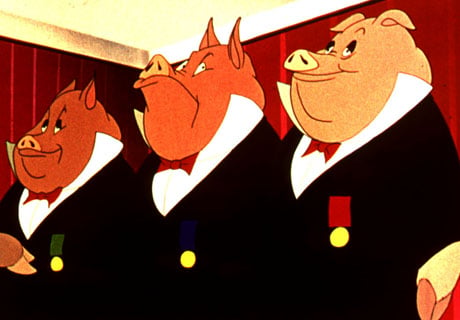
In Animal Farm, the pigs gradually twist and distort a rhetoric of socialist revolution to justify their behavior and to keep the other animals in the dark. The animals heartily embrace Major’s visionary ideal of socialism, but after Major dies, the pigs gradually twist the meaning of his words. As a result, the other animals seem unable to oppose the pigs without also opposing the ideals of the Rebellion. By the end of the novella, after Squealer’s repeated reconfigurations of the Seven Commandments in order to decriminalize the pigs’ treacheries, the main principle of the farm can be openly stated as “all animals are equal, but some animals are more equal than others.” This outrageous abuse of the word “equal” and of the ideal of equality in general typifies the pigs’ method, which becomes increasingly audacious as the novel progresses. Orwell’s sophisticated exposure of this abuse of language remains one of the most compelling and enduring features of Animal Farm.

As in 1984 the simplification of language use by the «power» (pigs in this novel), also makes other animals unable to think deeply about what is happening and, in addition to that, the simplistic dichotomies don’t give place to complex thoughts, so if an animal does not believe in of the statement made by the pigs, it is also opposing the ideals of the Rebellion.

For a deep analysis of the novel and this topic click here.

5. «Twelfth Night»

Read the comedy here!

**********************KEY FACTS****************************

Type of Work: Twelfth Night, or What You Will is a stage play in the form of a comedy. It was written in the festive spirit of the Twelfth Night of the Christmas season, January 6, as part of events celebrating the holiday season.

Date Written: 1601.

Publication: 1623 as part of the First Folio, the first auhorized collection of Shakespeare’s play.

**************************************************************************

Like many of Shakespeare’s comedies, this one centres on mistaken identity. The leading character, Viola, is shipwrecked on the shores of Illyria during the opening scenes. She loses contact with her twin brother, Sebastian, whom she believes is dead. Masquerading as a young page under the name Cesario, she enters the service of Duke Orsino through the help of the sea captain who rescues her. Orsino is in love with the bereaved Lady Olivia, whose father and brother have recently died, and who will have nothing to do with any suitors, the Duke included. Orsino decides to use «Cesario» as an intermediary to tell Olivia about his love for her. Olivia, believing Viola to be a man, falls in love with this handsome and eloquent messenger. Viola, in turn, has fallen in love with the Duke, who also believes Viola is a man, and who regards her as his confidant.

Olivia and Viola in Twelfth Night. 1979

The play’s delicious complications follow the emotional crosscurrents that Viola’s transformation engenders. Shipwrecked on a strange coast and bereft of her twin brother, the disguised Viola finds a place in the service of Duke Orsino with whom she promptly falls in love. When Orsino send Cesario to help him with the Lady Olivia, Olivia not only rejects the Duke’s suit but falls in love with his messenger. Discomforted to learn that she is the object of Olivia’s love, Viola reflects on the plot’s impassioned triangle:

My master loves her dearly,

And she, mistaken, seems to dote on me.

What will become of this?

(Act II, Scene II)

It would have been simple for Shakespeare to devise a concluding scene in which Viola appears in women’s habits, but he goes out of his way to leave her in men’s clothes and hence to disrupt with a delicate comic touch the return to the normal. The transforming power of costume unsettles fixed categories of gender and social class and allows characters to explore emotional territory that a culture officially hostile to same-sex desire and cross-class marriage would ordinarily have ruled out of bounds. In Twelfth Nigh, conventional expectations repeatedly give way to a different way of perceiving the world. Thus, Viola, dresses up as her brother whom she presumes to be dead, so as to pass safely through this strange land, leading to a great number of mistaken-identity gags. Inevitably, she becomes caught up in a bizarre love triangle between the duke she serves and loves and the countess she is wooing on his behalf, who naturally enough falls in love with her. And that’s not even getting into the high jinks between sober Malvolio and the drunken Sir Toby Belch. A shipwrecked Viola disguises herself as the boy Cesario and falls in love with her employer, Orsino, the duke of Illyria, who in turn is smitten with Olivia, who suddenly finds herself inexplicably attracted to Cesario/Viola. Olivia is so vulnerable, yearning and aware of her folly that the audience can’t wait for her every appearance. These misunderstandings, of course, are largely her creation, in the sense that they mainly derive from a disguise that confounds the distinction between male and female.

********************************************************************

<< PREVIOUS – NEXT >>

********************************************************************

Related posts:

Men and women roles in Elizabethan society.

The Comedy of Errors

Much Ado About Nothing

As You Like It

Conclusion

5. Conclusion

As we have seen, an important number of Shakespeare’s comedies deal with the issue of the roles of men and women at his times. Shakespeare represented at them the patriarchal society where he lived but also, through female characters as Beatrice, in Much Ado About Nothing, or Katherine, in The Taming of the Shrew, he presents women who don’t fit in the role they are supposed to play as women in the Elizabethan society. However we also see how this type of female characters are in some way obliged to adapt their behaviour in order to be accepted by society or even to protect their own life. This also happens in The Comedy of Errors, where Adriana seems to have a different idea about marriage and women and men freedom when talking with her sister or a man.

The use of the devise of mistaken identities provides Shakespeare the opportunity of accentuate the «virtual» differences between men and women, showing to the reader how the same person and the same ideas are received in different ways by society only because of the gender of that person.

*****************************************************************

Related posts:

Men and women roles in Elizabethan society.

The comedy of Errors

Much Ado About Nothing

As You Like It

Twelfth Night