"The universe is made of stories, not of atoms"

2. «Animal Farm»


Read Animal Farm here!

**********************KEY FACTS****************************

type of work:  Novella

Genre: Dystopian animal fable; satire; allegory.

Time and place written: 1943–1944, in London.

Date of first publication: 1946.

****************************************************************

As we have seen in the first paper, One of Orwell’s central concerns in Animal Farm is the way in which language can be manipulated as an instrument of control.

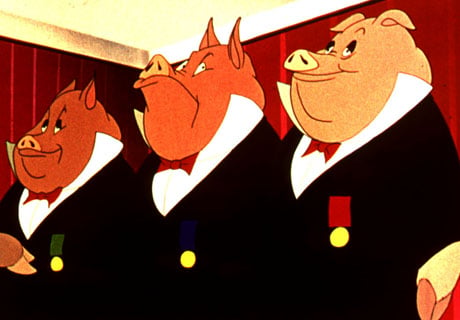
In Animal Farm, the pigs gradually twist and distort a rhetoric of socialist revolution to justify their behavior and to keep the other animals in the dark. The animals heartily embrace Major’s visionary ideal of socialism, but after Major dies, the pigs gradually twist the meaning of his words. As a result, the other animals seem unable to oppose the pigs without also opposing the ideals of the Rebellion. By the end of the novella, after Squealer’s repeated reconfigurations of the Seven Commandments in order to decriminalize the pigs’ treacheries, the main principle of the farm can be openly stated as “all animals are equal, but some animals are more equal than others.” This outrageous abuse of the word “equal” and of the ideal of equality in general typifies the pigs’ method, which becomes increasingly audacious as the novel progresses. Orwell’s sophisticated exposure of this abuse of language remains one of the most compelling and enduring features of Animal Farm.

As in 1984 the simplification of language use by the «power» (pigs in this novel), also makes other animals unable to think deeply about what is happening and, in addition to that, the simplistic dichotomies don’t give place to complex thoughts, so if an animal does not believe in of the statement made by the pigs, it is also opposing the ideals of the Rebellion.

For a deep analysis of the novel and this topic click here.

5. «Twelfth Night»


Read the comedy here!

**********************KEY FACTS****************************

Type of Work: Twelfth Night, or What You Will is a stage play in the form of a comedy. It was written in the festive spirit of the Twelfth Night of the Christmas season, January 6, as part of events celebrating the holiday season.

Date Written: 1601.

Publication: 1623 as part of the First Folio, the first auhorized collection of Shakespeare’s play.

**************************************************************************

Like many of Shakespeare’s comedies, this one centres on mistaken identity. The leading character, Viola, is shipwrecked on the shores of Illyria during the opening scenes. She loses contact with her twin brother, Sebastian, whom she believes is dead. Masquerading as a young page under the name Cesario, she enters the service of Duke Orsino through the help of the sea captain who rescues her. Orsino is in love with the bereaved Lady Olivia, whose father and brother have recently died, and who will have nothing to do with any suitors, the Duke included. Orsino decides to use «Cesario» as an intermediary to tell Olivia about his love for her. Olivia, believing Viola to be a man, falls in love with this handsome and eloquent messenger. Viola, in turn, has fallen in love with the Duke, who also believes Viola is a man, and who regards her as his confidant.

Olivia and Viola in Twelfth Night. 1979

The play’s delicious complications follow the emotional crosscurrents that Viola’s transformation engenders. Shipwrecked on a strange coast and bereft of her twin brother, the disguised Viola finds a place in the service of Duke Orsino with whom she promptly falls in love. When Orsino send Cesario to help him with the Lady Olivia, Olivia not only rejects the Duke’s suit but falls in love with his messenger. Discomforted to learn that she is the object of Olivia’s love, Viola reflects on the plot’s impassioned triangle:

My master loves her dearly,

And she, mistaken, seems to dote on me.

What will become of this?

(Act II, Scene II)

It would have been simple for Shakespeare to devise a concluding scene in which Viola appears in women’s habits, but he goes out of his way to leave her in men’s clothes and hence to disrupt with a delicate comic touch the return to the normal. The transforming power of costume unsettles fixed categories of gender and social class and allows characters to explore emotional territory that a culture officially hostile to same-sex desire and cross-class marriage would ordinarily have ruled out of bounds. In Twelfth Nigh, conventional expectations repeatedly give way to a different way of perceiving the world. Thus, Viola, dresses up as her brother whom she presumes to be dead, so as to pass safely through this strange land, leading to a great number of mistaken-identity gags. Inevitably, she becomes caught up in a bizarre love triangle between the duke she serves and loves and the countess she is wooing on his behalf, who naturally enough falls in love with her. And that’s not even getting into the high jinks between sober Malvolio and the drunken Sir Toby Belch. A shipwrecked Viola disguises herself as the boy Cesario and falls in love with her employer, Orsino, the duke of Illyria, who in turn is smitten with Olivia, who suddenly finds herself inexplicably attracted to Cesario/Viola. Olivia is so vulnerable, yearning and aware of her folly that the audience can’t wait for her every appearance. These misunderstandings, of course, are largely her creation, in the sense that they mainly derive from a disguise that confounds the distinction between male and female.

********************************************************************

<< PREVIOUS – NEXT >>

********************************************************************

Related posts:

Men and women roles in Elizabethan society.

The Comedy of Errors

Much Ado About Nothing

As You Like It

Conclusion

5. Conclusion


As we have seen, an important number of Shakespeare’s comedies deal with the issue of the roles of men and women at his times. Shakespeare represented at them the patriarchal society where he lived but also, through female characters as Beatrice, in Much Ado About Nothing, or Katherine, in The Taming of the Shrew, he presents women who don’t fit in the role they are supposed to play as women in the Elizabethan society. However we also see how this type of female characters are in some way obliged to adapt their behaviour in order to be accepted by society or even to protect their own life. This also happens in The Comedy of Errors, where Adriana seems to have a different idea about marriage and women and men freedom when talking with her sister or a man.

The use of the devise of mistaken identities provides Shakespeare the opportunity of accentuate the «virtual» differences between men and women, showing to the reader how the same person and the same ideas are received in different ways by society only because of the gender of that person.

*****************************************************************

Related posts:

Men and women roles in Elizabethan society.

The comedy of Errors

Much Ado About Nothing

As You Like It

Twelfth Night

4. «As You Like It»


Read the comedy here!

**********************KEY FACTS****************************

Type of Work: As You Like It is a comedy. Its rural locale and subject matter also qualify it as a pastoral romance. Shakespeare wrote the lines of the play in verse and in prose.

Date Written: 1599 or earlier.
First Printing: 1623 as part of the First Folio, the first authorized collection of Shakespeare’s plays.

***************************************************************************

Women were only allowed on stage after 1660, following the downfall of Cromwell’s puritanical government. The first recorded female actor in England was Margaret Hughes, who played Desdemona in Thomas Killigrew’s production of Othello. The female character who has the most lines is Rosalind, the heroine of As You Like It, who has more lines than any of Shakespeare’s female characters.

The dramatic use of disguise is found in comedy, above all, as a means of misunderstanding, intrigue and confusion. Besides, the use of disguise implies one of the most important conventions in Shakespeare’s times: the feminine character is obliged to adopt a masculine role due to different issues. Shakespeare uses this convention in five of his comedies, such as The Two Gentlemen of Verona (1594-95), The Merchant of Venice (1596-97), As You Like It (1599-1600), Twelfth Night (1599-1600), and Cymbeline (1609-10). In this paper we are going to deal with two of these comedies As You Like It and Twelfth Night, and we will try to analyze the relevance of this fact within the plays.

The use of the disguise has several connotations which include aspects like the production, the external perception of the other characters towards the disguised character, the disguise effectiveness, the dramatic tension, the character’s motivations, or the linguistic features. As for the production, in the Elizabethan theatre, feminine roles were played by young men. So, the fact that a young lady, as a main character, decided to disguise as a man, created a difficult play of identities: the young actor will end playing a woman who is trying to play a young man at the same time. Moreover, this leads to an interaction between appearance and reality. However, actresses disguised as men seem to be a provocation for the church.

Although said disguise was seen as provocative, it comes up as a mechanism which allows the liberation or the social emancipation for those people who adopt it: all the heroines manage to overcome all the imposed restrictions on women of the epoch thanks to the use of the disguise. Besides, this offers Shakespeare the possibility to allow disguised women to make subtle comments about the social interaction between the man and the woman. In addition, the effectiveness of the disguise also implies that women have to adopt an appropriate discourse to their new role, a masculine register. So, the disguise becomes an instrument for women to put them at the same social level as men. It also provides women the authority and free movements that are required by the circumstances in which they are involved. However, the women’s ability to adapt to their discourse will be crucial for the control and success of the play.

Much of the fun in Shakespeare’s comedies comes from the sexual confusion of the characters in the plays. Rosalind is the daughter of the exiled Duke Senior who has been banished and has gone to the Forest of Arden. She and her cousin Celia, disguised as Ganymede, a young man, and Aliena, a peasant girl, escape to the forest. Rosalind enters the Forest of Arden in search of freedom but the costume also gives her freedom. It was a patriarchal society in which women were under male control so becoming a boy gives her a kind of freedom she had never felt before. The place of women in renaissance society was limited to specific rules and limitations, guided by lessons of virtue and demure conduct. In her boy’s disguise, she escapes (for a time) the limitations of being a woman . She learns a great deal about herself, about Orlando, and about love itself which she could not have done within the normal conventions of society.

In this play we can observe the importance of the convention of costumes at theatre and the sex confusion scenes in Shakespearian drama. Here we have the male character Orlando, a young boy who is in love with Rosalind, and he meets Ganymede in the forest. Orlando doesn’t recognize Rosalind, and believing that Ganymede is a teenage boy, treats him as a male confidant and talks to him about his love for Rosalind. Ganymede teases Orlando about this woman he is in love with and promises to cure Orlando of his love, provided that Orlando courts Ganymede as if he were Rosalind. Orlando agrees to play this game.

Ganymede makes Orlando pretend that she is Rosalind so he may woo her and the joke is, of course, that she is really Rosalind. The gender ambiguities become quite intricate.Sometimes Rosalind shows her real identity to Orlando. In these scenes she behaves like a woman, she accuses him of not really loving her, and when she pretends to be Ganymede, she tries to teach him the proper way to win her heart. She is educating her own lover.

The disguise is very obvious to the audience but is unnoticed by the characters in the play. Cross-dressing, sexual identity, and the performance of gender are among the most hotly discussed topics in contemporary cultural studies. This play is a better example of Shakespeare’s uses of the heroine in male disguise-man-playing-woman-playing-man. And at the same time, seeing a woman dressed as a man would be extremely comic. It is comic when Rosalind tries to swagger and come across as convincingly male, but the audience, who know the truth, notice how awkward her attempts often are. But Orlando and the other characters, although sometimes confused by the mistakes Rosalind makes, are willing to believe that her awkwardness is the awkwardness of a boy in his late teens trying to come across as an adult male. Her duplicity produces more confusions in the play, the female character called Phoebe falls in love with Ganymede, because she thinks he is a real boy. On the stage, Phoebe is a girl in love with another girl (Rosalind), that’s what the audience see, it could be seen as a little reference to lesbianism, or to homosexuality between men, as long as Phoebe is, actually, a young boy, an actor, and Rosalind is also a male actor, and homosexuality wasn’t socially accepted in Elizabethan times. Homoheroticism occurs in some Shakespearian plays in a rather subversive way, masked with enough ambiguity to escape censure, like the relationship between Antonio and Bassanio in The Merchant Of Venice.

The role of Rosalind is for actresses what Hamlet is for actors, compared with her, all the other figures in the play seem to be just stock dramatic types. She plays a dominant role, though here Celia, Touchstone and Jaques are less flat in comparison to Rosalind. Celia and Rosalind both show indomitable tongues (when mocking Le Beau and confusing him utterly when asking him the colour of his sport), and though Rosalind takes over the action when they reach Arden, Celia shares the stage at Court with her in equal degree, acting as a sister when poking fun at Rosalind’s melancholy. Even in Arden Celia ends up as being less vibrant than Rosalind. She is important not only because of her double role but also because of her witness, her wisdom and charm. She is a complicated character, a genius, and she has long monologues in the play. The epilogue of the play is a monologue of her:

It is not the fashion to see the lady the epilogue; but it is no more unhandsome than to see the lord the prologue. If it be true that good wine needs no bush, ‘tis true that a good play needs no epilogue; yet to good wine they do use good bushes, and good plays prove the better by the help of good epilogues. What a case am I in then, that am neither a good epilogue, nor cannot insinuate with you in the behalf of a good play! I am not furnished like a beggar, therefore to beg will not become me: my way is, to conjure you; and I’ll begin with the women. I charge you, O women! for the love you bear to men, to like as much of this play as please you: and I charge you, O men! for the love you bear to women, ‘as I perceive by your simpering none of you hate them ,’that between you and the women, the play may please. If I were a woman I would kiss as many of you as had beards that pleased me, complexions that liked me, and breaths that I defied not; and, I am sure, as many as have good beards, or good faces, or sweet breaths, will, for my kind offer, when I make curtsy, bid me farewell. (Act 5, Scene 4)

******************************************************************

<<PREVIOUS –  NEXT>>

******************************************************************

Related posts:

Men and women roles in Elizabethan society.

The Comedy of  Errors

Much Ado About Nothing

Twelfth Night

Conclusion
Language as instrumental to the abuse of power and mind control in Animal Farm


Introduction

The most effective form of communication in society is speech, that is language. Language serves many functions, which include informative, entertaining and persuasive. In a political context it involves attracting attention and controlling listeners. The purpose of this paper is to analyze some features in Animal Farm that are of characteristics of the language of politics, portraying language as an instrument for attracting attention and controlling listeners.

It is also important when talking about George Orwell related to politics, to be familiarize with the events that marked his life and which made him reject any kind of totalitarian society:

George Orwell was educated in prestigious English schools with an atmosphere of constant taunting and endless competition for scholarship where he developed a contempt for any type of authority. He enlisted in the Indian Imperial Police when he was twenty years old, so during five years he witnessed imperialism rejecting it. In addition to that, when in 1936 the Spanish Civil War broke out, he joined the Republican side taking part into the conflict. During this period he saw the perversion of language through propaganda used as an instrument of war and mind control. It was specially during this war, and because of the conflict between Troskists and Stalinists, that George Orwell moved away from his early ideals.

Unlike many British socialists in the1930s and1940s, Orwell was not enamored of the Soviet Union and its policies, nor did he consider the Soviet Union a positive representation of the possibilities of socialist society. He could not turn a blind eye to the cruelties and hypocrisies of Soviet Communist Party, which had overturned the semifeudal system of the tsars only to replace it with the dictatorial reign of Joseph Stalin. Orwell became a sharp critic of both capitalism and communism, and is remembered chiefly as an advocate of freedom and a committed opponent of communist oppression.

Please, for a further study on George Orwell’s life and the historical context of Animal Farm before continuing reading the paper, click on the links:

_________________________________________

(table of contents)<<PREVIOUS – NEXT>> (overall view of Animal Farm)

Bibliography_ 1st paper_ Shakespeare


_Jhonston, Ian. Critical Approaches to Shakespeare: Some Initial Observations [on-line]. May 1999, November 2001 [ref. November 2010]. Available in World Wide Web:

< http://records.viu.ca/~johnstoi/eng366/approaches.htm >

_Mabillard, Amanda. Shakespeare’s Audience: The Groundlings [on-line]. Shakespeare Online. 20 Aug. 2000. [ref. November 2010]. Available in World Wide Web:

< http://www.shakespeare-online.com/essays/shakespeareaudience.html >

_Mabillard, Amanda. Entertainment in Elizabethan England [on-line]. Shakespeare Online. 20 Aug. 2000. [ref. November 2010]. Available in World Wide Web:

< http://www.shakespeare-online.com/faq/entertainment.html>

_McMillan, Eric. The Greatest Authors of all Time: William Shakespeare [on-line]. 2002-2003 [ref. October 2010]. Available in World Wide Web:

< http://www.editoreric.com/greatlit/authors/Shakespeare.html >

_Encyclopaedia Britannica. Guide to Shakespeare [on-line]. [ref. October 2010]. Available in World Wide Web:

< http://www.britannica.com/shakespeare >

_Wikipedia. William Shakespeare [on-line]. [ref. October 2010]. Available in World Wide Web:

< http://en.wikipedia.org/wiki/William_Shakespeare >

_Wikipedia. Elizabethan Era [on-line]. [ref. October 2010]. Available in World Wide Web:

< http://en.wikipedia.org/wiki/Elizabethan_era >

_Wikipedia. The Taming of the Shrew [on-line]. [ref. October 2010]. Available in World Wide Web:

< http://en.wikipedia.org/wiki/The_Taming_of_the_Shrew >

_Gray, Terry A. The Taming of the Shrew. 25 April 1998. [ref. October 2010]. Available in World Wide Web:

<http://shakespeare.palomar.edu/lambtales/LTSHREW.HTM>

_Gardner, Patrick and Phillips, Brian. SparkNote on The Taming of the Shrew. 22 March 2007. [ref. October 2010]. Available in World Wide Web:

<http://www.sparknotes.com/shakespeare/shrew/characters.html>

Bibliography, URL’s _ first paper_ literatura inglesa y discurso politico


C.D. Merriman. “Geworge Orwell”. The Literature Network [on-line]. 2006 [ref. October 2010]. Available in World Wide Web: < http://www.online-literature.com/orwell/ >

Kerr, Douglas. «Orwell’s BBC Broadcasts: Colonial Discourse and the Rhetoric of Propaganda» [on-line].  Textual Practice, Volume 16, No. 3.  Charles’ George Orwell Links. December 2002 [ref. October 2010]. Available in World Wide Web:  < http://www.netcharles.com/orwell/articles/bbc-colonial-discourse.htm >

Pearce, Robert. «Orwell Now» [on-line]. History Today. Charles’ George Orwell Links. October 1997 [ref. October 2010]. Available in World Wide Web:< http://www.netcharles.com/orwell/ctc/docs/orwlnow.htm >

Wikipedia. «George Orwell» [on-line]. [ref. October 2010]. Available in World Wide Web:  < http://en.wikipedia.org/wiki/George_Orwell >

Wikipedia. «Animal Farm» [on-line]. [ref. October 2010]. Available in World Wide Web:  < http://en.wikipedia.org/wiki/Animal_Farm >

SparkNotes Editors. “SparkNote on Animal Farm.” SparkNotes LLC. 2007 [ref. October 2010] Available in World Wide Web: < http://www.sparknotes.com/lit/animalfarm/ >

____________________________

BACK TO ABSTRACT

«Animal Farm» historical context


The theme of Animal Farm is not difficult to understand. Orwell intended to criticize, in an allegorical way, the totalitarian communist regime he saw in Russia. Though he agreed with many Marxist principles, Orwell was unable to accept the communist interpretation of socialism because he saw many similarities between the communist governments and the previous czarist regimes in old Russia. Communism, he thought, was inherently hypocritical.

So, in order to understand better the events described by George Orwell in his famous novel Animal Farm, it is important to know the revolution that took place during the first half of the 20th Century in Russia that destroyed the  Tsarist autocracy and led to the creation of the Soviet Union, paying special attention to its political system  that was characterized by the superior role of the Communist Party of the Soviet Union (CPSU) which in fact became the only party permitted by Constitution.

Due to the complexity of the events, here  we are going to focus on the Soviet history under Communist Party rule, beginning with the October Revolution of 1917 and how it is related to the system established in Animal Farm, but I recommend you to visit the links provided below for further information and a better understanding of the allegorical meaning of the novel:

  • BBC documentary:  An analysis of Animal Farm as a representation of the corruption of the revolution by its leaders and of the rise and fall of Stalinism.

George Orwell «Animal Farm»_ historical context.

  • Documentary dealing with the Russian Revolution:

Part 1 (Duration : 09:38)

Part 2 (Duration : 09:25)

Part 3 (Duration : 09:49)

  • Original reports from The Times:

Russian Revolution 1917

  • Wikipedia’s article about the Russian Revolution:

Russian_Revolution_(1917)

_________________________________________________________

Russian society in the early twentieth century was bipolar: a tiny minority controlled most of the country’s wealth, while the vast majority of the country’s inhabitants were impoverished and oppressed peasants. Communism arose in Russia when the nation’s workers and peasants, assisted by a class of concerned intellectuals known as the intelligentsia, rebelled against and overwhelmed the wealthy and powerful class of capitalists and aristocrats. They hoped to establish a socialist utopia based on the principles of the German economic and political philosopher Karl Marx.

In February 1917, Tsar Nicholas II, the monarch of Russia, abdicated and the socialist Alexander Kerensky became premier. At the end of October, Kerensky was ousted, and Vladimir Lenin, the architect of the Russian Revolution, became chief commissar. Almost immediately, as wars raged on virtually every Russian front, Lenin’s chief allies began jockeying for power in the newly formed state; the most influential included Joseph Stalin, Leon Trotsky, Gregory Zinoviev, and Lev Kamenev. Trotsky and Stalin emerged as the most likely heirs to Lenin’s vast power. Trotsky was a popular and charismatic leader, famous for his impassioned speeches, while  Stalin preferred to consolidate his power behind the scenes. After Lenin’s death in 1924, Stalin orchestrated an alliance against Trotsky that included himself, Zinoviev, and Kaminev. In the following years, Stalin succeeded in becoming the unquestioned dictator of the Soviet Union and had Trotsky expelled first from Moscow, then from the Communist Party, and finally from Russia altogether in 1936. Trotsky fled to Mexico, where he was assassinated on Stalin’s orders in 1940.

In 1934, Stalin’s ally Serge Kirov was assassinated in Leningrad, prompting Stalin to commence his infamous purges of the Communist Party. Holding “show trials”. Stalin had his opponents officially denounced as participants in Trotskyist or anti-Stalinist conspiracies and therefore as “enemies of the people,” an appellation that guaranteed their immediate execution. As the Soviet government’s economic planning faltered and failed, Russia suffered under a surge of violence, fear, and starvation. Stalin used his former opponent as a tool to placate the wretched populace. Trotsky became a common national enemy and thus a source of negative unity. He was a frightening specter used to conjure horrifying eventualities, in comparison with which the current misery paled. Additionally, by associating his enemies with Trotsky’s name, Stalin could ensure their immediate and automatic elimination from the Communist Party.

These and many other developments in Soviet history before 1945 have direct parallels in Animal Farm: Napoleon ousts Snowball from the farm and, after the windmill collapses, uses Snowball in his purges just as Stalin used Trotsky. Similarly, Napoleon becomes a dictator, while Snowball is never heard from again. Orwell was inspired to write Animal Farm in part by his experiences in a Trotskyist group during the Spanish Civil War, and Snowball certainly receives a more sympathetic portrayal than Napoleon. Every animal character in the novel is based on one «protagonist» of the Russian Revolution:

But though Animal Farm was written as an attack on a specific government, its general themes of oppression, suffering, and injustice have far broader application and modern readers have come to see Orwell’s book as a powerful attack on any political, rhetorical, or military power that seeks to control human beings unjustly.

Meet George Orwell


Eric Arthur Blair, better known by his pen name George Orwell and as the author of Animal Farm and 1984, was born in 1903 in Bengal, region of Eastern India, which was part of the British Empire. He was son of Richard Walnesley Blair, who worked in the Opium Department of Indian Civil Service, and Ida Mabel Blair. Due to certain gradual impoverishment of his family, he always described it as «lower-upper-middle class».

Only one year after his birth, his mother moved to England with him and his two sisters. George Orwell did not see his father again until 1912, when his father joined them.

George Orwell was educated in England in prestigious boarding schools as a scholarship student, but he felt oppressed by the strict control this schools exercised over their students, in fact he wrote an essay, Such, Such Were the Joys, based on his experiences there, describing the social challenges he endured as a scholarship student among England’s wealthy elite. This essay was published 2 years after his death. It was possibly a source of his initial resentment towards authority.

After graduating at Eton secondary school in 1921, and because of the economic situation of his family, which could not afford college, Eric Arthur Blair joined the Indian Imperial Police, in Burma.  There  he was working until 1927, when due to a Dengue fever he contracted but specially to his increasing disillusionment with the reality of British imperialism in India, which made him suspicious of the established class system in English society,  he decided to resign from the Indian Imperial Police and to become a writer. Works he wrote influenced by this period of his life are the novel Burmese Days (1934) and the essays A Hanging (1931) and Shooting an Elephant (1936).

Once back in England, he became devoted to the problems of class and government power, and inspired by Jack London’s 1903 book The People of the Abyss, Orwell bought ragged clothes from a second-hand store and went to live among the very poor in London. In the spring of 1928, he moved to Paris, where the bohemian lifestyle offered an attraction for many aspiring writers. After reemerging, he published a book about these experiences, entitled Down and Out in Paris and London (1933), and The Spike, his first published essay.

As a young man, Orwell became a socialist, speaking openly against the excesses of governments, and using the pseudonym, George Orwell, he began writing articles for magazines. In 1936 Orwell was commissioned by Victor Gollancz to produce a documentary account of unemployment in the north of England for his Left Book Club. The Road to Wigan Pier established Orwell as one of Britain’s leading writers and marked a high point in literary journalism.

On 9 June 1936 Orwell married Eileen O’Shaughnessy and In 1944 they would adopt a son, Richard Horatio. When Civil War broke out in Spain in 1936, Blair and his wife both wanted to fight for the Spanish government against Francisco Franco’s Nationalist uprising. He traveled to Spain to report on the Spanish  War, where he witnessed firsthand the nightmarish atrocities committed by fascist political regimes. While on the front at Huesca in Aragon Blair was shot in the throat by “a Fascist sniper”. Orwell stepped into a complex political situation in Catalonia. The Republican government was supported by a number of factions with conflicting aims, including the Workers’ Party of Marxist Unification (POUM — Partido Obrero de Unificación Marxista), the anarcho-syndicalist Confederación Nacional del Trabajo and the Unified Socialist Party of Catalonia (a wing of the Spanish Communist Party, which was backed by Sovietarms and aid). The ILP was linked to the anti-Stalinist Spanish Trotskyist ‘Partido Obrero de Unificación Marxista’ or POUM,  so Orwell joined the POUM. When the communists partly gained control and tried to purge the POUM, many of Blair’s friends were arrested, shot, or disappeared. He and Eileen barely escaped to England in June 1937. His autobiographical Homage to Catalonia is written in the first person, few months after the events. In the book Orwell attempted to expose the propaganda disseminated by newspapers in Britain. This included attacks on both the right-wing press and the Daily Worker, a paper controlled by theCommunist Party.

Unlike many British socialists in the1930s and1940s, Orwell was not enamored of the Soviet Union and its policies, nor did he consider the Soviet Union a positive representation of the possibilities of socialist society. He could not turn a blind eye to the cruelties and hypocrisies of Soviet Communist Party, which had overturned the semifeudal system of the tsars only to replace it with the dictatorial reign of Joseph Stalin. Orwell became a sharp critic of both capitalism and communism, and is remembered chiefly as an advocate of freedom and a committed opponent of communist oppression.  The rise to power of dictators such as Adolf Hitler in Germany and Joseph Stalin in the Soviet Union inspired Orwell’s mounting hatred of totalitarianism and political authority. Orwell devoted his energy to writing novels that were politically charged, his two greatest anti-totalitarian novels—Animal Farm (1945) and 1984 (1949)—form the basis of his reputation.

Back in England, Orwell set to freelance writing  for such publications as New English Weekly, The Tribune and New Statesman, writing essays about different authors like Charles Dickens, William Butler Yeats or Arthur Koestler.

On the outbreak of World War II Orwell was declared unfit for any kind of military service by the Medical Board in June, but soon afterwards found an opportunity to become involved in war activities by joining the Home Guard. In August 1941, Orwell finally obtained «war work» when he was taken on full time by the BBC’s Eastern Service. He supervised cultural broadcasts to India to counter propaganda from Nazi Germany designed to undermine Imperial links. This was Orwell’s first experience of the rigid conformity of life in an office. However it gave him an opportunity to create cultural programmes with contributions from T. S. Eliot, Dylan Thomas, E. M. Forster, Ahmed Ali, Mulk Raj Anand, and William Empson among others. By February 1945 David Astor had invited Orwell to become a war correspondent for the Observer. During wartime, Orwell and his wife adopted a son, but his wife died shortly afterwards, on 29 March 1945. Also during this time, Orwell completed Animal Farm. The book met with immediate and far-reaching public success.

Orwell continued to write for periodicals while completing his second renowned novel,1984. He remarried, in 1949, to Sonia Brownell.

Orwell, who was prone to illness, had his career and his life cut short when he died of tuberculosis on January 21, 1950. His friend, David Astor, arranged for Orwell’s burial in a small county churchyard. Orwell is buried under his birth name. He left a strong literary and political legacy, being one of those artists who influenced not only the literary universe, but also the real world in which he lived. As he wrote in his essay Politics and the English Language: «In our age there is no such thing as ‘keeping out of politics.’ All issues are political issues, and politics itself is a mass of lies, evasions, folly, hatred and schizophrenia.»

_______________________________

If you are interested in a more detailed biography you can visit the links below for more information:

You can also find interesting pictures and videos about George Orwell at this blog:

________________________________

<<BACK to table of contents – NEXT : Animal Farm historical context>>

George Orwell: images


Picture of George Orwell which appears in an old acreditation for the BNUJ. 1933

George Orwell's signature.

NEXT>>