Before reading the paper, please read The Taming of the Shrew or, at least, a summary of the plot.
Katherine: an attempt of breaking social rules
In The Taming of the Shrew, Shakespeare creates a troubling comedy that explores Elizabethan issues of gender or gender roles: that is, the socially accepted definitions of appropriate male and female behavior.
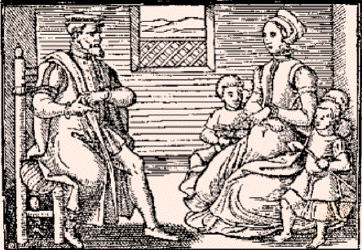
On the surface, the play appears to confirm a very traditional Elizabethan view that men should dominate women and that women should submit to male authority. All of the characters except Katherina agree throughout the play that her initial rebellious, self-assertive, «shrewish» behavior is not acceptable. Analyzing the different characters throughout the play, we can find a reflection of how Elizabethan society was:
- Baptista: We can see in this character how men thought of their wives and daughter as their property, expecting from them to be docile and obedient. He is one of the wealthiest men in Padua, and his daughters, Bianca and Katherina, become the prey of many suitors due to the substantial dowries he can offer. His absentmindedness increases when Kate shows her obstinate nature. Thus, at the opening of the play, he is already desperate to find her a suitor, having decided that she must marry before Bianca does.
- Bianca: The younger daughter of Baptista. The “lovely” Bianca can be considered the opposite of her sister, Kate, at the beginning of the play. This character is the stereotype of the perfect women during Shakespeare’s time: she is soft-spoken, sweet, and unassuming. Because of her large dowry and her mild behavior, several men vie for her hand. It is important to remember at this point that Marriage was seen as the desirable state for both men and women, and single women were sometimes looked upon with suspicion.
- Petruchio: Petruchio represents the man who conceives marriage as a business, although he will take care of his wife. Petruchio is a gentleman from Verona. Loud, boisterous, eccentric, quick-witted, and frequently drunk, he has come to Padua “to wive and thrive.” He wishes for nothing more than a woman with an enormous dowry, and he finds Kate to be the perfect fit.
Signor Hortensio, ‘twixt such friends as we
Few words suffice; and therefore, if thou know
One rich enough to be Petruchio’s wife—
As wealth is burden of my wooing dance—
Be she as foul as was Florentius’ love,
As old as Sibyl, and as curst and shrewd
As Socrates’ Xanthippe or a worse,
She moves me not—or not removes at least
Affection’s edge in me, were she as rough
As are the swelling Adriatic seas.
I come to wive it wealthily in Padua;
If wealthily, then happily in Padua.
(I.ii.62–73)
Disregarding everyone who warns him of her shrewishness, apart from his prospective wife’s wealth, Petruchio says that he does not care about any of her other qualities. This speech exemplifies Petruchio’s brash, robust manner of speaking. He is blatantly honest about his materialism and selfishness, and he also straightforwardly acknowledges the economic aspect of marriage—something that everyone in the play is keenly aware of but which only Petruchio discusses so frankly and openly and with so little concern for romantic love. In spite of this, we can see a strong sexual attraction between Katherina and Petruchio as well as a growing comradeship. Moreover, although Petruchio seeks to control Katherina, at the end he appears to admire and value her spirit.
- Lucentio: Just as Bianca is Katherine’s opposite, the intrepid, lovesick Lucentio serves as a foil for Petruchio throughout the play. Lucentio reflects the sort of idyllic, poetical view of love that Petruchio’s pragmatism dismisses: Lucentio is struck by love for Bianca at first sight, says that he will die if he cannot win her heart, and subsequently puts into motion a romantic and fanciful plan to do so. Whereas love in the play is often mitigated by economic and social concerns, Lucentio is swept up in a vision of courtly love that does not include the practical considerations of men like Petruchio. Throughout much of the play, then, Lucentio and Bianca’s relationship appears to be refreshing and pure in comparison to the relationship between Petruchio and Katherine. Petruchio’s decision to marry is based on his self-proclaimed desire to win a fortune, while Lucentio’s is based on romantic love.
- Katherine: she is a character that does not fit in the stereotype of the Elizabethan woman. Katherine is the “shrew” of the play’s title, the daughter of Baptista Minola, with whom she lives in Padua. Widely reputed throughout Padua to be a shrew, Kate is foul-tempered and sharp-tongued at the start of the play. She constantly insults and degrades the men around her, particularly anyone who tries to marry her. Her hostility toward suitors particularly distresses her father. Though most of the play’s characters simply believe Katherine to be inherently ill-tempered, it is certainly plausible to think that her unpleasant behavior stems from unhappiness because she feels out of place in her society. Throughout the play Shakespeare made a big change in the way Katherine seems to conceive marriage and the role of men and women, she does not resist her suitor Petruchio forever, though, and she eventually subjugates herself to him, despite her previous repudiation of marriage.
Due to Katherine’s intelligence and independence, she is unwilling to play the role of the maiden daughter, the “perfect woman”. She clearly abhors society’s expectations that she obey her father and show grace and courtesy toward her suitors. At the same time, however, Katherine must see that given the rigidity of her social situation, her only hope to find a secure and happy place in the world lies in finding a husband. These inherently conflicting impulses may lead to her misery and poor temper. A vicious circle ensues: the angrier she becomes, the less likely it seems she will be able to adapt to her prescribed social role; the more alienated she becomes socially, the more her anger grows.
Thanks to this character, Shakespeare was able to present in front of the audience the problems of a society where gender roles were so rigid, Where women with desires of independence, who are capable of taking care of themselves and who are sure about being equal to men, were treated as a wild animal which needs to be tamed. The play is, in fact, a comedy about an assertive woman coping with how she is expected to act in the society of the late sixteenth century and of how one must obey the unwritten rules of a society to be accepted in it.
We can understand the taming of Katherine and the play’s attitude toward gender roles in different ways:
- Although the play ends with her outwardly conforming to the norms of society, this is in action only, not in mind. Although she assumes the role of the obedient wife, inwardly she still retains her assertiveness. I this sense, Katherina’s final speech should be read ironically, with the implication that she will pretend to defer to Petruchio in public while ruling the household in private.
Thy husband is thy lord, thy life, thy keeper,
Thy head, thy sovereign . . .
Such duty as the subject owes the prince,
Even such a woman oweth to her husband,
And when she is froward, peevish, sullen, sour,
And not obedient to his honest will,
What is she but a foul contending rebel
And graceless traitor to her loving lord?
I am ashamed that women are so simple [foolish]
To offer war where they should kneel for peace,
Or seek for rule, supremacy, and sway,
When they are bound to serve, love, and obey.
(5.2.148-66 / Katherine’s final speech)
This adaptation to to her social role as a wife must be attractive to Katherine on some level, since even if she dislikes the role of wife, playing it at least means she can command respect and consideration from others rather than suffer the universal revulsion she receives as a shrew.
- The play ultimately accepts and reinforces male dominance of women as it shows how a woman can only be happy acting as she is expected to do and being obedient to his father and husband, reason why Katherine changes his mind about marriage, etc.
- While accepting male dominance the play emphasizes the need for mutual affection, cooperation, and partnership in marriage.
- The play ultimately undermines male dominance of women by showing this dominance to be artificial and illogical.
In my opinion, and taking into account the way in which Shakespeare presented the play before the audience, I think that Shakespeare’s intention was the first one of the options presented above, and I do so because of the different devices used by Shakespeare in order to distance the audience from what happens in the play.One must also take into account the attitudes of sixteenth century England and the fact that the play is a comedy and is not meant to be taken seriously.
The play-within-a-play structure emphasizes to the audience that what they are about to see is a performance, not reality, but someone’s interpretation of reality in a satirized way, exaggerating the features of characters such as Katherine or Petruchio. In this way, the audience didn’t feel scandalized in front of a woman who rejects, at least at the beginning, her social role and the superiority of men.
In addition to that, Shakespeare chose a setting for the play far away from where the audience was from, Italy. Doing so he achieved to stress that what they were watching was not reality but a performance, so they did not have such problems about social and gender roles.
Confusion between appearance and reality is a principal source of humor in The Taming of the Shrew, giving place to grotesque situations. In the Induction, Sly is misled by carefully orchestrated appearances into believing that he is really a wealthy nobleman rather than a poor tinker. The subplot likewise depends on the confusion of appearance and reality as various characters practice elaborate deceptions. Hortensio pretends to be the music teacher Litio. Lucentio poses as the schoolmaster Cambio. He and Bianca use Latin lessons as a cover for their courtship, and they deceive her father by eloping on the eve of her planned betrothal to another man. Lucentio’s servant, Tranio, pretends to be his master and persuades an elderly scholar to pose as his master’s father. Following with the device of false realities that Shakespeare set in place so early in the play, it would seem more logical that Katherine would simply be acting the part of ‘the obedient wife’ in order to be accepted in the society in which she lives. Katherine can ‘play a part’ very well and can even enjoy doing it. In fact, It is difficult to believe that a character as vibrant and strong-willed as Katherine is changed/”tamed” so easily.
________________________
<<Social role of women during the Elizabethan era — Conclusion>>